Briefing Archive Breaking News Glossary Earnings Analysis
March 31, 2026 (Tuesday)
The Morning Briefing

1U.S. equities on March 30 delivered a mixed session as rising energy prices clashed with a selloff in the technology sector. The Dow Jones Industrial Average edged up +49.50 points (+0.11%) to close at 45,216.14, while the S&P 500 fell -0.39% to 6,343.72 and the Nasdaq declined -0.73% to 20,794.64. Fed Chair Powell, speaking at Harvard, said "rates are in a good place" and signaled caution on rate hikes despite the oil surge triggered by the Iran war.

2With the de facto blockade of the Strait of HormuzStrait of HormuzA roughly 33km-wide strait connecting the Persian Gulf and the Gulf of Oman. Approximately 20% of the world's oil shipments pass through here. Located between Iran and Oman, it serves as the main artery for Middle Eastern crude exports. continuing, WTI crude closed at +3.25% at $102.88. The energy sector has posted an overwhelming YTD gain of +22%. Meanwhile, the technology sector remained under pressure, falling more than -1%, with Micron Technology (MU) extending its post-earnings slide with a -10% drop. Concerns over reduced AI memory demand from Google's TurboQuant algorithm weighed on the entire semiconductor complex.

3The flight to safety continued, pushing the U.S. 10-year Treasury yield down to 4.36% (-8bp). The VIXVIX (Fear Index)A volatility index derived from S&P 500 option prices. Readings below 20 indicate stability, while readings above 30 signal elevated anxiety. Also known as the "fear gauge." remained elevated at 25.33. USD/JPY traded at 159.65 (-0.38%). Gold hit $4,524, up +15% YTD. Bitcoin was flat at $66,500. Key events this week include the ISM Manufacturing PMIISM Manufacturing PMIThe Purchasing Managers' Index published by the Institute for Supply Management (ISM). A reading above 50 indicates economic expansion; below 50 signals contraction. Widely regarded as a leading economic indicator. on April 1 and the employment report on April 3 (Good Friday, market closed).

S&P 500 6,343.72 -0.39%
NASDAQ 20,794.64 -0.73%
Dow 45,216.14 +0.11%
VIX 25.33 Elevated
US 10Y 4.36% -8bp
USD/JPY 159.65 -0.38%
WTI $102.88 +3.25%
Gold $4,524 +
BTC $66,500 Flat
TOP STORY
Federal Reserve Building
Photo: Pexels
ECONOMY

Fed Chair Powell Says "Rates Are in a Good Place" — No Hike Needed Despite Iran War Oil Surge

Fed Chair Jerome Powell, speaking at Harvard on March 30, said "rates are in a good place" despite the surge in oil prices triggered by the Iran war, reaffirming a cautious stance on rate hikes. Powell noted that "by the time the full effects of monetary tightening filter through the economy, the oil shock will likely have passed. It would burden the economy at an inopportune time." He assessed that inflation expectations remain "well anchored beyond the near term," while adding that "it is critically important to closely monitor inflation expectations." Following his remarks, the probability of a rate hike by December fell to 2.2%.
💡
Why it matters: By treating the oil shock as "transitory" and shelving the rate-hike option, the Fed has pushed back the market's worst-case scenario — stagflationStagflationA condition where economic stagnation and inflation occur simultaneously. It became prominent during the 1970s oil crises. Monetary policy becomes extremely difficult to calibrate under these conditions. combined with monetary tightening. The bond market rallied in relief.
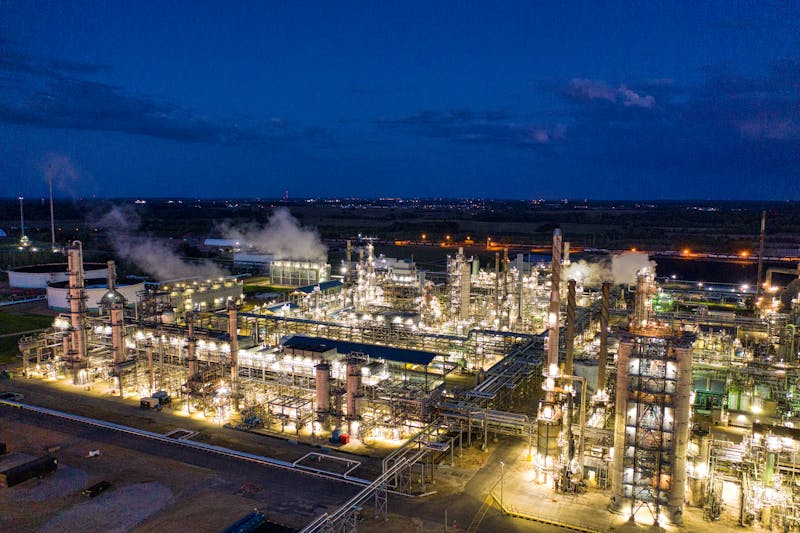
Oil refinery at night Photo: Pexels
GEOPOLITICS Al Jazeera / CNBC
Crude Tops $100 as the New Normal — Strait of Hormuz Crisis Drives Energy Stocks to +22% YTD
With the de facto blockade of the Strait of Hormuz continuing, WTI crude is trading at $102.88 and Brent near $114. The IEA has called it "the largest supply disruption in history." An estimated 4.5 to 5 million barrels per day have been taken offline, with volumes expected to double by mid-April. The energy sector leads the S&P 500 at +22% YTD. ExxonMobil is up +35% and Chevron +40%, posting record gains. Meanwhile, Iran has begun allowing vessels from five countries — China, Russia, India, and others — to transit the strait, and humanitarian shipments have been permitted since March 27.
⚠️
Why it matters: The blockade of the Strait of Hormuz, through which 20% of global oil supply flows, has triggered the worst energy crisis since the 1970s. Rising energy costs are hitting corporate earnings and consumer spending, the ECB has postponed rate cuts, and recession risks are climbing.
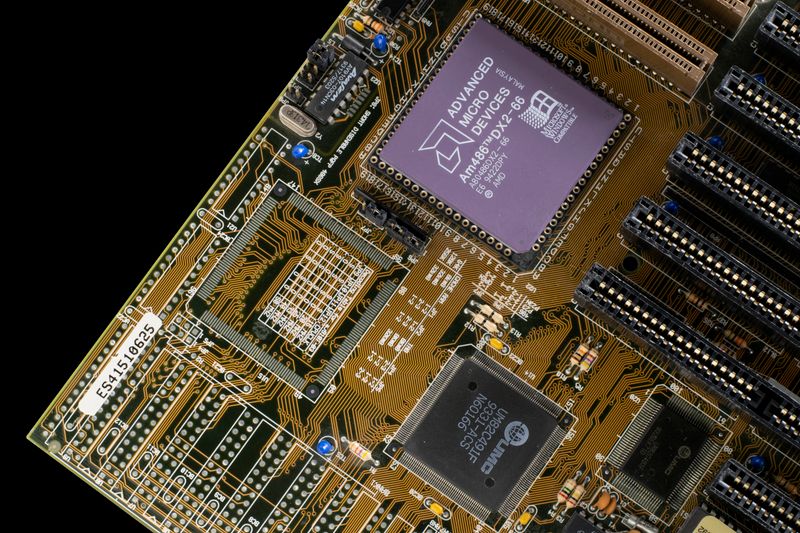
Close-up of a microchip processor Photo: Pexels
TECH CNBC / Motley Fool
Micron Slides Another 10%, Down 30% Since Earnings — Google TurboQuant Shock Spreads Across Chips
Micron Technology (MU) fell 10% on March 30, bringing its total decline since its March 18 earnings report to roughly 30%. Despite a blockbuster quarter — EPS of $12.20 (vs. consensus $8.50) and revenue of $23.86B (vs. $18.90B) — Google's March 25 announcement of its AI memory compression algorithm "TurboQuant" raised the possibility of reducing KV cacheKV Cache (Key-Value Cache)A mechanism in large language model (LLM) inference that stores past token information as key/value pairs in memory. This avoids recomputation but consumes large amounts of GPU memory. memory demand by more than 6x, casting doubt on the long-term outlook for AI memory demand. Concerns over a $25B+ capex plan and a downgrade from Summit Insights added further pressure.
⚠️
Why it matters: TurboQuant is still at the research stage, but it challenges the assumption that "AI needs infinite memory." This could trigger a broader valuation reassessment across the semiconductor sector.
🔍 Our Take
TurboQuant remains in the research phase, and practical deployment is years away. Yet the market's outsized reaction reflects how much capital has been wagered on the premise that AI memory demand is "limitless." Micron's actual results were extraordinary (EPS beat by 43%), and the gap between fundamentals and share price continues to widen. For disciplined investors, this is a situation worth monitoring closely.
Luxury car interior Photo: Pexels
TECH TechCrunch / Bloomberg
Uber Acquires Premium Chauffeur Service Blacklane for $1.1B — Accelerating Its Upmarket Push
Uber announced on March 30 that it will acquire Berlin-based premium chauffeur service Blacklane for $1.1 billion. Founded in 2011, Blacklane operates airport transfers and chauffeur servicesChauffeur ServiceA premium, professional driver service offering luxury transportation for airport transfers, business meetings, and other occasions. Typically targeted at high-net-worth individuals and corporate executives. across more than 500 cities in over 60 countries. The deal is aimed at bolstering the recently announced "Uber Elite" brand, as the premium segment catering to affluent and business executive customers is growing rapidly. The acquisition is expected to close by end of 2026, subject to regulatory approval.
💡
Why it matters: This move signals Uber's strategic pivot. The shift from low-cost rideshare to high-margin premium services supports the company's margin improvement and long-term growth narrative.
Pharmacy shelves and pharmacist Photo: Pexels
ECONOMY Bloomberg / Axios
CVS to Post First Net Store Growth in Four Years — Plans ~60 New Locations Including Pharmacy-Only Format
CVS Health announced on March 30 that it will open approximately 60 new stores in 2026, marking its first net store growth in four years. After closing roughly 800 locations over the past three years, the company is introducing a new ~3,000 sq. ft. "pharmacy-only" format focused on prescriptions, immunizations, and pharmacist consultations. The first pharmacy-only store opened in Chicago on March 30, with Boston and Brooklyn locations planned for later this year.
📌
Why it matters: A landmark reversal for the U.S. pharmacy chain sector, shifting from contraction to expansion. The pharmacy-only format reflects the broader trend toward community-based healthcare delivery.
Data center server racks Photo: Pexels
TECH CNBC / TechCrunch
Mistral AI to Build 13,800 Nvidia GPU Data Center Near Paris — Raises $830M in Debt Financing
French AI startup Mistral announced on March 30 that it has secured $830 million in debt financing from a consortium of seven banks to build a data center housing 13,800 Nvidia GB300 GPUs. Participants include BNP Paribas, Credit Agricole CIB, HSBC, and MUFG. The facility will be located in Bruyeres-le-Chatel, south of Paris, with a total capacity of 44MW and is expected to come online in Q2 2026. The company plans to secure 200MW of compute capacity across Europe by end of 2027.
💡
Why it matters: Evidence that European AI infrastructure investment is accelerating. As a counterweight to U.S. players (OpenAI, Google), Europe is building its own sovereign AI foundation.
Close-up of a GPU board Photo: Pexels
TECH Motley Fool / GuruFocus
Nvidia's Forward PEForward PE (Forward Price-to-Earnings)A price-to-earnings ratio calculated using expected earnings per share over the next 12 months. Used to assess whether a stock is cheap or expensive relative to its future earnings outlook. Matches S&P 500 — A "Value" Signal Not Seen in a Decade
Nvidia's forward P/E ratio has converged with that of the S&P 500, drawing widespread attention. The company, which had commanded a premium valuation as the standard-bearer of the AI revolution over the past three years, is now trading at its lowest valuation since 2019 — pressured by risk-off sentiment from the Iran war, doubts about AI investment returns, and the Google TurboQuant overhang. The market is no longer asking "is AI transformative?" but rather "how many years until payback?" and "what is the right level of capex?"
⚠️
Why it matters: Is this the signal of an AI bubble bursting, or the buying opportunity of a decade? Nvidia's valuation compression carries implications for the entire AI investment thesis.
✍️ EDITORIAL

"Oil Shock vs. AI Reassessment" — The Anatomy of a Bifurcated Market

The U.S. equity market in Q1 2026 is grappling with a bifurcation that few anticipated. The energy sector has staged a historic rally of +22% year-to-date, while the technology sector — which led markets for the past three years — has entered a correction.

The structure of this bifurcation is clear. The Strait of Hormuz blockade, a classic "supply shock," has driven energy prices sharply higher and caused oil-related earnings to explode. ExxonMobil is up +35% YTD, Chevron +40%. Meanwhile, the tech sector faces a triple headwind: (1) cost pressures and macro slowdown fears from elevated oil prices, (2) questions about AI investment efficiency exemplified by Google's TurboQuant, and (3) the unwinding of stretched valuations.

Chair Powell's March 30 address clarified the Fed's policy stance toward this crisis. "We will not raise rates. The oil shock is transitory. By the time the tightening takes full effect, the shock will have passed." This provided relief to markets, but the question remains whether "transitory" will truly prove to be transitory.

This week, all eyes are on the April 1 ISM Manufacturing PMI (consensus 52.3) and the April 3 employment report (consensus +57,000 vs. prior -92,000). If the manufacturing PMI breaks below 50, recession fears will surge. If the jobs number disappoints, "stagflation" will dominate headlines.

The unusual scheduling of the employment report on Good Friday, when equity markets are closed, adds another layer of risk. The futures market may not be able to fully digest the data, concentrating risk into the following Monday's open.

From a portfolio standpoint, excessive concentration in energy carries its own risks. Iran's limited reopening of the strait (allowing transit for five countries) suggests that geopolitical risk is not unidirectional, and crude prices could reverse sharply. Whether the tech sector's valuation compression represents a "buying opportunity" or a "trend reversal" may well be determined by this week's economic data.

Disclaimer: This editorial does not constitute a recommendation to buy or sell any specific security. All investment decisions should be made at your own discretion and responsibility.
Oil tanker navigating the Strait of Hormuz Photo: Pexels
Iran IRAN UAE Musandam (Oman) Oman Saudi Arabia Qatar Persian Gulf Persian Gulf Gulf of Oman Gulf of Oman STRAIT OF HORMUZ BLOCKADED Blockade Zone Shipping Lane (Halted) of global oil transit ~20% passes through here
Strait of Hormuz
Strait of Hormuz — The World's Most Critical Oil Chokepoint
The Strait of Hormuz is a roughly 33km-wide waterway connecting the Persian Gulf to the Gulf of Oman, through which approximately 20-21% of the world's oil shipments transit. Located between Iran and Oman, it is the main artery for crude oil exports from Saudi Arabia, the UAE, Iraq, and Kuwait. Since the outbreak of the Iran war in March 2026, the Islamic Revolutionary Guard Corps (IRGC) has declared a blockade of the strait, effectively halting commercial shipping. The IEA has called it "the largest supply disruption in history."
🛢️
Energy Supply
20 million barrels per day of crude oil and large volumes of LNG transit the strait. The blockade has removed 5% of global supply (4.5-5 million bpd), with volumes expected to double by mid-April.
📈
Market Impact
Brent crude surged from ~$80 pre-blockade to a peak of $126. Energy stocks have posted historic gains while tech and consumer discretionary sold off in a classic "sector rotation."
🌍
Geopolitics
Iran has granted limited transit rights to five nations including China, Russia, and India. The geopolitical divide between Western nations and BRICS+ is now reflected in maritime shipping lanes.
💹
Investment Implications
The Energy Select Sector SPDR ETF (XLE) is up +22% YTD. Meanwhile, the ECB has postponed rate cuts and recession risks are rising. Geopolitical risk hedging in portfolios has become urgent.
📌 Today's Relevance WTI crude rose for the third consecutive day to $102.88. Chair Powell characterized the oil shock as "transitory" and ruled out rate hikes, but a prolonged blockade of the Strait of Hormuz could make inflationary pressures structural. The key question is how long the energy sector's outperformance can continue.
📖 Explore the Glossary →
3/31 (Tue)
🇺🇸 MEDIUM Consumer Confidence Index Prior: 98.3
🇪🇺 HIGH Eurozone CPI Flash Estimate (March) Consensus: 2.5%
4/1 (Wed)
🇺🇸 HIGH ISM Manufacturing PMI Prior: 52.4 / Consensus: 52.3
🇺🇸 HIGH Retail Sales (February) Consensus: +0.4% MoM
4/2 (Thu)
🇪🇺 MEDIUM Holy Thursday (many European markets closed)
4/3 (Fri)
🇺🇸 HIGH Nonfarm PayrollsNonfarm Payrolls (NFP)A core component of the U.S. employment report published by the Bureau of Labor Statistics on the first Friday of each month. It tracks the change in the number of employed persons across all non-agricultural industries and heavily influences the Fed's monetary policy decisions. (Employment Report) Prior: -92K / Consensus: +57K *Equity markets closed for Good Friday
🌅 BMO (Pre-Market)
SNX BMO
TD Synnex
IT Distribution
EPS: $3.24 Rev: $15.59B
🌙 AMC (After-Market)
NKE AMC
Nike
Sportswear & Apparel
EPS: $0.28 Rev: $11.2B
★ Watch: Turnaround progress, China market recovery
MKC AMC
McCormick
Food & Spices

This content is provided by U&I CO., LTD. for educational and informational purposes only and does not constitute a recommendation or solicitation to buy or sell any specific securities. The accuracy, completeness, and timeliness of the information presented is not guaranteed. All investment decisions should be made at your own discretion and responsibility. U&I CO., LTD. is not registered as a financial instruments business operator (investment advisory or agency business).